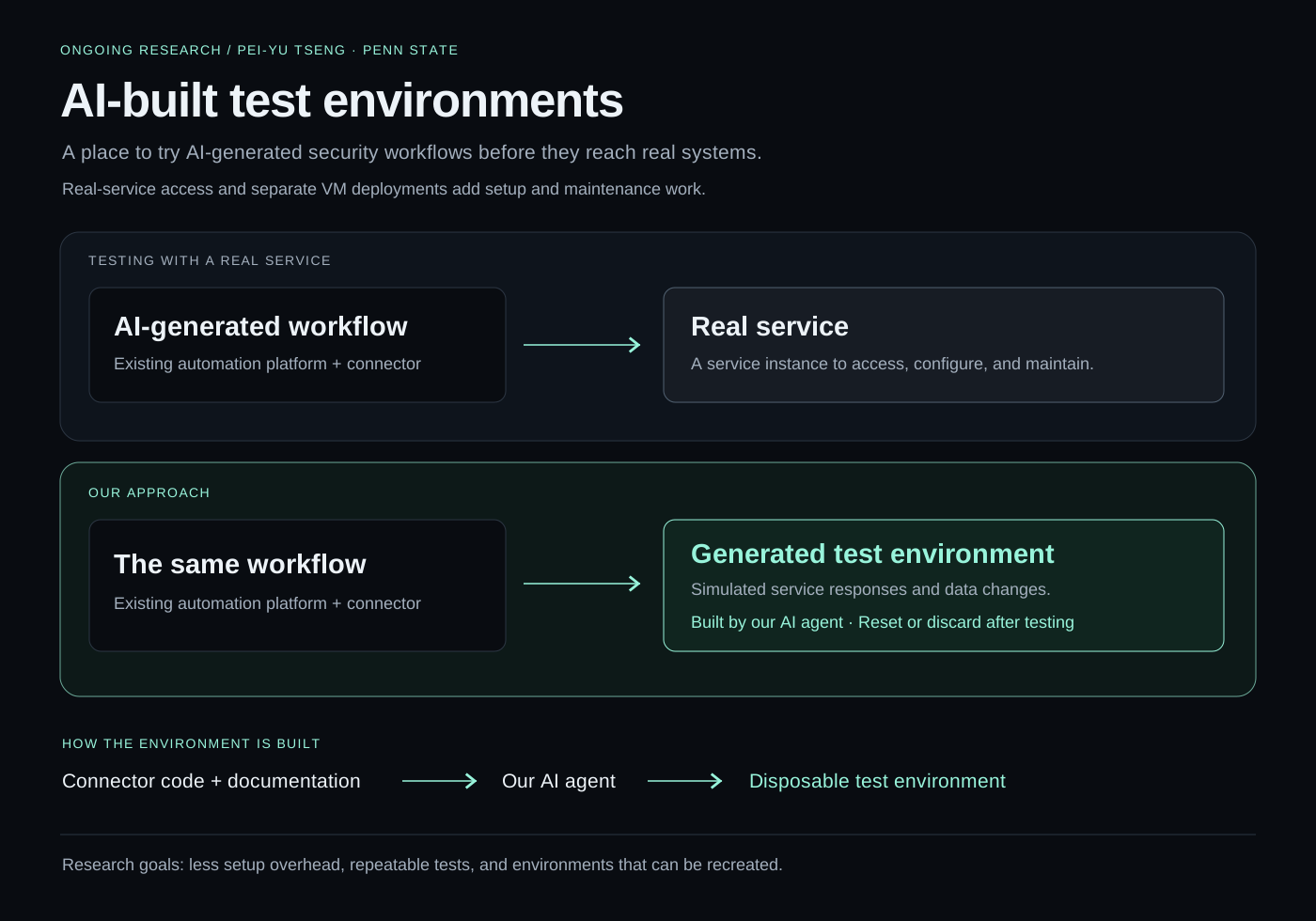
AI-built test environments
for security playbooks.
I build agents that generate disposable service environments for testing AI-created security workflows. The goal is lower-cost, repeatable testing without connecting to live systems.
A playbook is an automated sequence of security actions, such as investigating an alert or disabling an account. Generating the workflow is only part of the job: testing it needs services to interact with.
See the approachGenerate its test environment.
Both paths retain the existing security automation platform and service connector.
Existing SOAR platform + connector
This part stays the sameLive service data and actions
Service responses + state changes
Built by our AI agent · Reset or discard& documentation
Reads the interface.
Builds the environment.
- 1. Real service
- 2. Agent builds
- 3. Test here
The agent builds the service environment. Run the same playbook against it, then reset or discard the environment.
Connector code & documentation → agent → runnable service environment.
Less setup work
Agents generate service behavior from connector code and documentation.
Observable effects
Actions change stored data, so later calls can observe what happened.
Reset or discard
Choose the starting data, reset between tests, or rebuild the environment.
A workflow needs more
than a test button.
Existing methods each cover part of the job. Running a playbook also requires an environment that responds to its actions, with data you can control and restore.
| Testing method | What it helps check | What remains |
|---|---|---|
| Review the playbook | Check its structure and intended logic. | The service calls and their effects still need to be tested. |
| Supply fixed responses | Exercise branches and result handling. | Prewritten replies alone do not reproduce changes caused by earlier actions. |
| Run against real services | Observe actual integration and service behavior. | Prepare service access, test data, and cleanup; VM-based deployments add infrastructure to maintain. |
My research automates building that environment. The aim is to reduce the cost of maintaining full service deployments or writing substitutes by hand, while keeping the existing playbook and connector in the test path.
Existing end-to-end tests can verify behavior when supplied with suitable environments and checks. This work targets environment generation; test requirements still determine whether a playbook did the right thing.
From service interfaces
to runnable environments.
I develop the agent workflow that analyzes connector actions and their state relationships, generates the service implementation and initial data, and reviews behavior through the real SOAR platform and connector.
CURRENT STATUSOngoing research. Lower setup cost and faster rebuilding are design goals; comparative cost and provisioning-time results are not yet reported.
Technical details & research scope
Pipeline1 is the internal name of this environment-generation workflow. The execution path retains Splunk SOAR, the security automation platform, and its unmodified service connector.
- Read the connector code and documentation to identify required service behavior.
- Generate a service implementation and starting data that can be reset.
- Review action results and subsequent state changes through the existing connector.
The generated implementation supplies the modeled external-service behavior. Editable seed data initializes a separate runtime state that can be reset between tests. Builder and reviewer agents use behavioral acceptance conditions to guide implementation and repair.
The environment records action effects; separate task requirements and assertions judge playbook correctness. It does not establish complete equivalence with every behavior of the real service.